Does your business need a chatbot? The pros, the cons and a quick test
By Custom Software Solutions ·
We build and sell AI chat agents, so read this knowing that. We'd still rather tell you not to buy one than sell you something that sits in the corner of your website annoying people.
A chatbot is good at a fairly narrow job. If you have that job, it earns its keep. If you don't, there's usually a cheaper fix.
The pros
- It answers when you can't. At 9pm, on a Sunday, or while your hands are full with another customer.
- It doesn't mind repeating itself. Prices, hours, areas you cover, what to bring. The same answer every time it's asked, without interrupting your day.
- It can collect what you need to reply. Instead of "how much?", you get a date, a town, the job and an email address in one go.
- It shows you what people want to know. Read the conversations and you'll find the questions your website isn't answering.
The cons
- It costs money, and keeps costing. There's the setup, then a monthly fee or a bill that grows with use.
- It goes out of date. Change a price or your hours and someone has to tell it, or it will keep giving the old answer.
- It can get things wrong. Good instructions make that much less likely. They don't make it impossible.
- You may be answerable for what it says. In 2024 a Canadian tribunal ordered Air Canada to compensate a passenger after its website chatbot gave wrong advice about a bereavement fare. The airline argued it wasn't responsible for what the chatbot said. The tribunal disagreed.
- Some people would rather talk to you. For a lot of local businesses, being able to ring and get a real person is the selling point.
- It's one more place customer details end up. You need to know who can see them and tell people what happens to them.
When a chatbot is worth it
The same questions, and the answer depends on a few details. The Pixie Polish Shop runs mobile nail parties for kids. Parents ask about packages, dates and towns, often while the owner, Shayne, is busy painting nails. Her chat helper gathers an email, a rough date, a town and a package, then passes the enquiry to her. It never confirms a date, because only she can.
People need answers while they're partway through something. In IntegrateMe, a staff onboarding app we built, an AI assistant called Mandy answers a new starter's questions whenever they think of them, so the manager isn't the only source of answers.
When to skip it

A page would answer the question. If people keep asking your price, put the price on your website. It's free to run and it can't make anything up.
You only get a few enquiries. If you can comfortably reply to all of them yourself, a chatbot has very little to save you.
The real answer needs a person to look. A leak under a sink, a quote that depends on the site, a complaint. A good form and a phone number do the job. Manna Plumbing's website works with exactly that: an enquiry form and a click-to-call button.
A wrong answer could hurt someone. Health, legal and money advice shouldn't come from a chat box on your website. A bot can safely give opening hours for a clinic. It shouldn't be telling anyone whether their symptoms can wait.
Your answers change by the hour. If people mostly want to know what's free or in stock right now, a bot is only useful if it's connected to your live system. That's a much bigger job.
Nobody will look after it. If no one is going to follow up the enquiries or update the answers, wait until someone will.
A five-question test
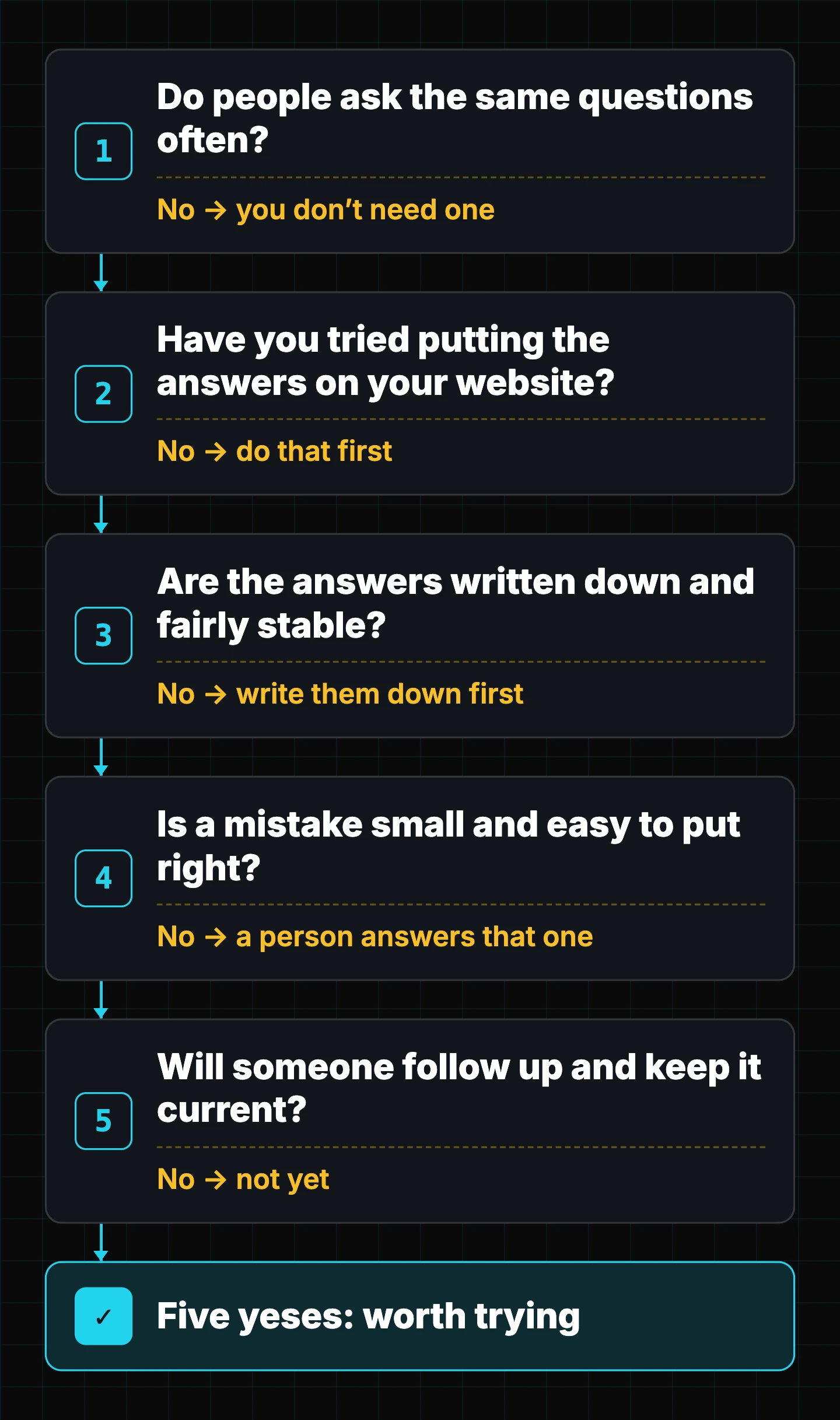
- Do people ask you the same questions often? If not, you don't need one.
- Have you already tried putting the answers on your website? If not, do that first.
- Are the answers written down, and do they stay the same for weeks at a time? If not, write them down and see how often they change.
- If it gets something wrong, is the harm small and easy to put right? If not, keep a person in charge of that answer.
- Will someone follow up the leads and keep it current? If not, not yet.
Five yeses means it's worth trying.
Not sure?
Spend a week writing down every question you get by phone, text, email and Messenger. That list will tell you more than any sales pitch. It's also the first thing a chatbot would need to learn.
You can try our demo chat agent, which answers for a made-up coffee roaster. Our chat agents cost $2,000 + GST to set up and $99 + GST a month, so weigh that against how many enquiries you'd really save. If you're thinking of doing it yourself, we've compared building your own with having one built. Or tell us about your week of questions and we'll say honestly whether we think a chatbot would help.